

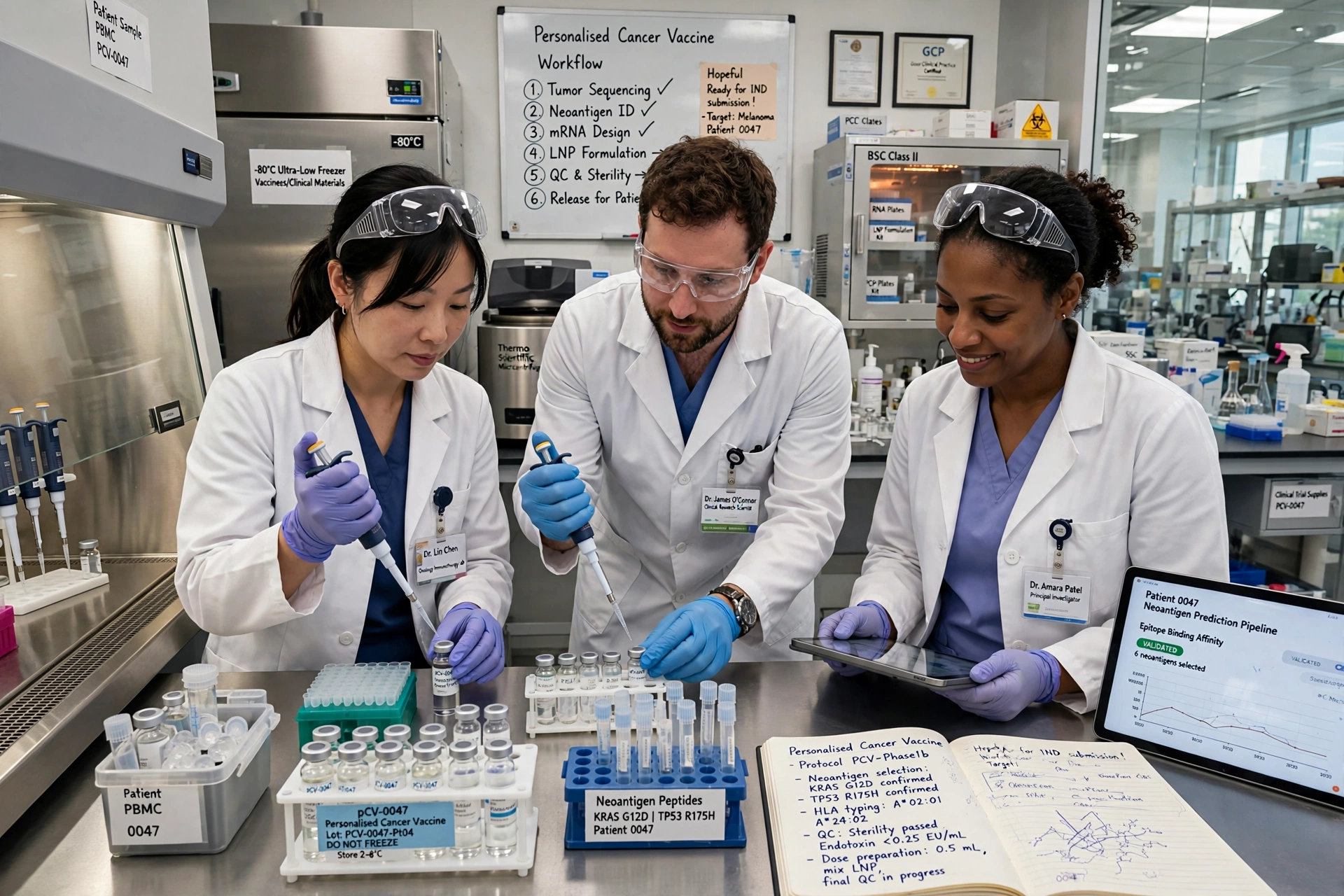
The science is intricate, but the question in a first trial is simple: can we actually do this safely? For NeoVax, a personalised vaccine targeting tumour neoantigens, combined with nivolumab in platinum-sensitive ovarian cancer, a phase 1 study in Nature Medicine answers yes on feasibility and reports acceptable safety.
It also belongs in a wider conversation about how care is changing, reflected in our coverage of glucose monitors in diabetes, where measurement, timing and personal biology increasingly shape the choices doctors and patients make together. Personalised vaccines take that same instinct — treat the individual, not just the diagnosis — to its logical extreme.
Why nivolumab was added
Nivolumab plays a complementary role. It belongs to a class of immunotherapies that release a brake on immune cells, helping them stay active against cancer. Combining a vaccine that points the immune system at specific targets with a drug that loosens its restraints is a rational pairing, at least in theory. The phase 1 setting was designed to test whether that theory could be turned into a practical, tolerable treatment schedule for real patients, not yet whether it improves survival.
A difficult cancer to treat
Ovarian cancer presents particular challenges. Tumours are often widespread by diagnosis, the disease has a strong tendency to recur, and responses to immunotherapy alone have historically been modest. Selecting patients whose cancer was platinum-sensitive — meaning it had previously responded to platinum-based chemotherapy — gave researchers a defined group in which to explore the combination carefully and learn how future, larger trials should be designed.
What phase 1 can and cannot tell us
The cautions deserve equal prominence. Phase 1 trials are small and are built to study safety, dosing and practicality, not to prove that a treatment works. An acceptable safety profile means side effects were within what investigators considered manageable; it does not mean the treatment was free of adverse effects, and it certainly does not mean efficacy has been established. Anyone reading headlines should hold that distinction firmly in mind.
The manufacturing challenge
What happens next will matter more than what has happened so far. Larger, randomised studies would need to compare outcomes for patients who receive the vaccine combination with those receiving standard care, and to follow participants long enough to judge recurrence and survival. Manufacturing must also become faster and more scalable if personalised vaccines are ever to reach routine practice rather than remain a feat of logistics for a fortunate few.
What should happen next
Even with those caveats, the direction of travel is significant. A treatment assembled from a patient’s own tumour biology, delivered alongside established immunotherapy, and shown to be feasible in a difficult cancer, points towards a more individual future for oncology. It is early-stage research, and patients should discuss any trial with their own specialist team, but as a proof that the machinery works, this small study carries weight well beyond its size.
Flags that only cancer cells fly
Neoantigens are the key concept. When cancer cells accumulate mutations, they produce abnormal proteins that healthy cells do not display. Fragments of those proteins, presented on the cell surface, can act as flags for the immune system. A neoantigen vaccine aims to teach immune cells to recognise those flags. Because the flags differ from patient to patient, the vaccine must be personalised, which is why feasibility — actually making the right product in time — is a meaningful result in itself. Background on the journal’s coverage is available from Nature.
There is also a value question that future trials cannot dodge. Personalised vaccines are labour-intensive and therefore expensive to produce. If larger studies eventually show benefit, health systems will need evidence strong enough to justify the cost per patient. Feasibility today is step one; affordability, if efficacy follows, will be a debate in its own right.
A measured reason for interest
For now, the honest summary is a short one: a personalised vaccine for ovarian cancer can be made, can be combined with nivolumab, and passed an early safety and feasibility test in a carefully chosen group of patients. Whether it can change outcomes is the larger, harder question that only bigger trials can answer. In a field where progress is often measured in small, verified steps, this is one of those steps — real, limited, and worth taking seriously without overstating.
